Curriculum

IB School Curriculum

Introduction to the Primary Years Programme (PYP)

At Podar International School, we follow the IB Primary Years Programme from Grade 1 to Grade 5.

The PYP is a curriculum framework based on the most current best practiced educational research from around the world.

The PYP prepares students for the intellectual challenges of further education and their future careers while focussing on the development of the whole child as an inquirer, both in the classroom and in the world at large.

The programme aims to develop students’ academic, social and emotional wellbeing. through a focus on international mindedness and strong personal values.

The PYP Curriculum Framework

The Primary Years Programme (PYP) offers a transdisciplinary, inquiry-based and student-centered education with responsible action at its core, enabling students to learn between, across and beyond traditional subject boundaries. The framework serves as the curriculum organizer and offers an in-depth guide to achieve authentic conceptual inquiry-based learning that is engaging, significant, challenging and relevant for PYP students.

Through the programme of inquiry and by reflecting on their learning, PYP students develop knowledge, conceptual understandings, skills and the attributes of the IB Learner profile.

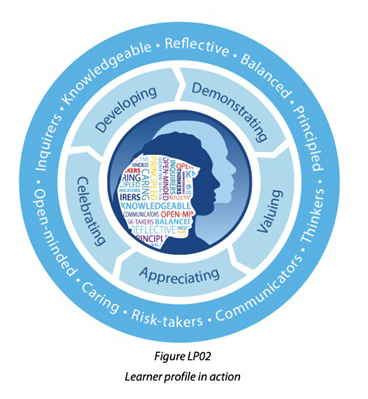
The Learner profile is the core of the model and the whole IB Philosophy, it also makes reference to the student-centered education.

The IB’s six approaches to teaching and five approaches to learning guide and focus educators and students in IB World Schools.

The approaches are centred on a cycle of inquiry, action and reflection—an interplay of asking, doing and thinking—that informs the daily activities of teachers and learners. (What is an IB education? 2019)

`Agency and self-efficacy are fundamental to learning in the PYP. Throughout the programme, the learner is an agent for their own and others’ learning. They direct their learning with a strong sense of identity and self-belief, and in conjunction with others, build a sense of community and awareness for the opinions, values and needs of others.

Action, the core of student agency, is integral to the PYP learning process and to the programme’s overarching outcome of international mindedness. 

curriculum_Transdisciplinary Themes

Transdisciplinary Themes:

Who we are

Where we are in place and time

How we express ourselves

How the world works

How we organize ourselves

Sharing the planet

Within the IB School Curriculum, the six transdisciplinary themes encourage exploration that is relevant to PYP learners around the world and the diverse communities they belong to. These themes frame the programme of inquiry and provide a starting point for students to engage with both local and global issues and opportunities. Together, they create authentic, relevant, and transformative learning experiences that go beyond traditional subject boundaries.

The pillars of the PYP curriculum framework

The transdisciplinary model is a core element of the  IB PYP Programme, extending across the three pillars of its curriculum framework: the learner, learning and teaching, and the learning community.

The learner

Describes the outcomes for individual students and the outcomes they seek for themselves (what is learning?) https://ibo.org/programmes/primary-years-programme/curriculum/the-learner/

Learning and teaching

Articulates the distinctive features of learning and teaching (how best to support learners?) https://ibo.org/programmes/primary-years-programme/curriculum/learning-and-teaching/

The learning community

emphasises the importance of the social outcomes of learning and the role that IB communities play in achieving these outcomes (who facilitates learning and teaching?) https://ibo.org/programmes/primary-years-programme/curriculum/the-learning-community/

The Learner Profile

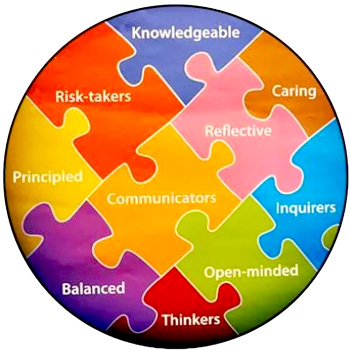
The attributes of the learner profile represent a broad range of human capacities and responsibilities that encompass intellectual, personal, emotional and social growth.

The development and demonstration of these attributes are foundational to students becoming internationally minded, active and caring community members who respect themselves, others and the world around them.

The learner profile supports students in developing international-mindedness and in taking action for positive change. Exercising their agency, students take ownership of their learning, express their ideas and opinions, and reflect on their development of the learner profile attributes.

The Learner Profile in action

The learner profile supports students in developing international-mindedness and in taking action for positive change. Exercising their agency, students take ownership of their learning, express their ideas and opinions, and reflect on their development of the learner profile attributes.

Students have a range of opportunities to develop, demonstrate and reinforce attributes of the learner profile in the daily life of the learning community.


Curriculum

Within the IB school curriculum, the learner profile is embedded across learning experiences. Students explore these attributes through transdisciplinary inquiry and subject-specific learning while developing skills, conceptual understanding, and meaningful action.

Learning spaces and social interactions

Opportunities to apply and practice the learner profile attributes are present in diverse learning spaces such as the library, music room,, and across everyday social contexts. This includes interactions during break and lunch times, sports, after-school activities, and field trips.

School events

Events such as assemblies, drama productions, and sports days provide further occasions for students to showcase and deepen their understanding of the learner profile. These collective experiences help foster a shared sense of identity and community.

Home and wider community

The development of the learner profile extends beyond the school. Through interactions with family members, friends, local businesses, sports clubs and community groups, students have the opportunity to embody the attributes in real-world contexts.

School culture and communication

The learner profile shapes the culture of the school, evident in class agreements, playground expectations, and pastoral care approaches. It also serves as a common language in communications through newsletters, school websites, and visual displays.

Feedback and reflection

Within the IB School Curriculum, students regularly use the learner profile to reflect on their learning and to give and receive feedback. The attributes are highlighted and celebrated in learning journals, reports, and peer interactions, supporting continuous growth and constructive dialogue.

Critical thinking tools

The learner profile offers a framework for critically exploring local and global challenges. Students learn to question and analyze various perspectives, communication styles, and social issues using the lens of the learner profile.

Approaches to Teaching

To foster this dynamic environment, our educators are guided by the IB’s six key pedagogical principles. Teaching at Podar International School is:

Student agency is fundamental to this process. Learners at Podar direct their own learning with a strong sense of identity and self-belief. Action, the core of student agency, is integral to the PYP, empowering students to make a positive impact on the world.

Explore the PYP at Podar

We invite you to discover how the Primary Years Programme at Podar International School can nurture your child’s potential.

Our Curriculum - Cambridge Lower Secondary (Grade 6 & 7)

The Middle School curriculum for Grades 6 and 7 seamlessly integrates the Cambridge Primary and Lower Secondary curriculum with the innovative approach of inquiry. This blend fosters academic excellence in subjects like English, Math, Science (Physics, Chemistry, Biology), and languages (French, Hindi, Spanish) and Computing while also emphasizing interdisciplinary learning in Individuals and Societies. Through co-curricular activities such as Performing Arts, Visual Arts, Robotics, and Physical Education, our students develop into well-rounded, creative and socially aware individuals prepared for future success.

French

The French curriculum for Grades 6 and 7 integrates language acquisition with global awareness, learner well-being, and intercultural understanding. Students progressively build their listening, speaking, reading, and writing skills through engaging units from the Tricolore series, using methods such as role play, reciprocal teaching, and comic strips. Formative and summative assessments are designed with differentiation to foster critical thinking, creativity, and confidence. The programme also incorporates international perspectives, encouraging students to explore French culture, festivals, food, travel, and everyday life through inquiry-based, real-world activities.

Spanish

The Spanish curriculum is designed to develop students’ language proficiency through integrated skills in reading, writing, listening, and speaking, while fostering cultural understanding. Learners will build foundational grammar, including verb conjugations in the present, imperfect, and past tenses, and use diverse vocabulary to describe people, places, routines, and experiences. A strong emphasis is placed on real-life communication, such as discussing health, making plans, exploring food traditions, and narrating personal stories. Students will also compare Spanish and their own cultures, reinforcing their learning through creative tasks like role plays, emails, storytelling, and collaborative projects.

Hindi

The Grade 6 Hindi curriculum demonstrates a comprehensive integration of reading, writing, listening, and grammar skills, thoughtfully distributed across thematic units. Each month’s plan includes clear learning objectives, learner attributes, and differentiated assessments such as comic strips, note-making, verbal tasks, and comprehension exercises. The curriculum adopts varied teaching strategies like Think-Pair-Share, reciprocal teaching, and Socratic dialogue to engage learners and build critical thinking. A strong emphasis is placed on wellbeing, global citizenship, and value education through discussions on sustainability, empathy, justice, and international cultures. Overall, the curriculum successfully aligns academic learning with holistic

Computing

The computing curriculum equips students with skills to design, write, and evaluate programs using concepts such as algorithms, flowcharts, variables, sequences, selection, and iteration. Learners will create practical projects including chatbots, interactive games, databases, and spreadsheets, applying their knowledge to solve real-world problems. The programme fosters understanding of computer systems, networks, hardware, and data security while exploring the use of robots and automation in industry. Students will also compare text-based and block-based programming languages, learning when and how to apply each effectively.

Individuals and Societies

Individuals & Societies curriculum fosters inquiry through globally relevant themes, integrating key concepts like systems, change, and time, place, and space. In Grade 6, students explore topics such as tribal societies, ancient civilizations, rivers, and healthcare evolution, building understanding of culture, governance, sustainability, and development. Grade 7 deepens critical engagement through units on culture, natural hazards, tourism, and early civilizations, encouraging reflection on identity, innovation, and societal responses. The curriculum is aligned with the UN Global Goals, connecting classroom learning with global challenges like clean water, sustainable communities, and good health. Through critical thinking, communication, and investigation, students are guided to become informed, responsible global citizens.

Our Curriculum - Cambridge Upper Secondary (Grade 8 - 10)

Empowering Learners and creating high-performing World citizens.

At Podar International School, we are committed to nurturing globally competent, ethical, and high-performing world citizens through the prestigious Cambridge IGCSE (International General Certificate of Secondary Education) programme, offered by Cambridge Assessment International Education (CAIE).  Our IGCSE curriculum builds not only academic knowledge but also develops critical thinking, collaboration, and problem-solving skills, ensuring our students are future-ready and responsible global citizens.

The subjects offered at IGCSE are as follows:

First Language English (0500)
French Foreign Language (0520)
Spanish Foreign Language (0530)
Hindi as a Second Language (0549)
Environmental Management (0680)
Economics (0455)
Business Studies (0450)
Accounting (0452)
Physics (0625)
Chemistry (0620)
Biology (0610)
Mathematics (0580)
International Mathematics (0607)
Information and Communication Technology (0417)
Art and Design (0400) (Optional)
Food & Nutrition (0648) (Optional)

Our Curriculum: Cambridge Advanced (A LEVELS)

The Cambridge International As & A Level Qualification

Cambridge International AS & A Level develops learners’ knowledge, understanding and skills in:

As & A Level Curriculum

Students opt for four subjects, with English being a compulsory component, alongside three additional subjects

The subjects we offer are:

A Level Science Stream (Any Three)

How does the school support and develop the Cambridge Learner Attributes?

Confident

Students are keen to explore and evaluate ideas and arguments in a structured, critical and analytical way. Debate the effects of economic issues. Pitch a business idea in a classroom.

They are able to communicate and defend views and opinions as well as respect those of others- Present findings from science  practical experiments to peers. Explain financial statements in peer presentations.

Responsible

Students take ownership of their learning, set targets and insist on intellectual integrity while using real data sources accurately in analysis. They understand that their actions have impacts on others and on the environment. Follow safety protocols during experiments.

Reflective

Students understand themselves as learners. They are concerned with the processes as well as the products of their learning and develop the awareness and strategies to be life-long learners Learn from errors in trial balance or statements. Review what made real businesses succeed or fail. Evaluate the ethical impact of biological research. Review lab work to understand what went wrong/right.

Innovative

Student’s welcome new challenges and meet them resourcefully, creatively and imaginatively. They are capable of applying their knowledge and understanding to solve new and unfamiliar problems. They can adapt flexibly to new situations requiring new ways of thinking. Design a new experiment to test a scientific principle. Propose solutions to economic problems. Develop marketing strategies for a new product.

Engaged

Students are alive with curiosity, embody a spirit of enquiry. They are keen to learn new skills and are receptive to new ideas. They work well independently but also with others.  Follow current economic news and apply theories to real-world situations. Explore real-world science applications. Connect math concepts to real-world applications like finance, physics, or data analysis.

Our Curriculum: IBDP

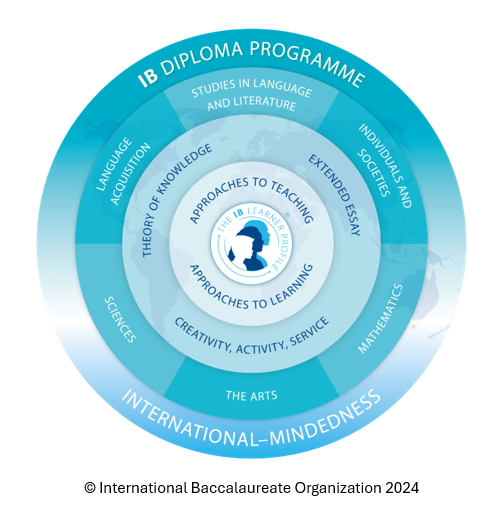
The IB Diploma Programme at Podar International School

Podar International School is recognised as the best IBDP school in Mumbai, accredited to offer the International Baccalaureate Diploma Programme for students in Classes XI and XII. The programme provides a globally respected academic pathway that prepares learners for leading universities worldwide.

The IB Diploma Programme is a rigorous two-year curriculum that offers a balanced blend of academic depth and global perspective. Guided by the IB mission and learner profile, it nurtures inquiring, knowledgeable, and compassionate individuals. Students develop intercultural understanding, critical thinking, and the skills needed to contribute to a more peaceful and responsible world.

Unique to the IB Programme are the three core components:

Theory of Knowledge (TOK)

Develops a coherent approach to learning that unifies the academic disciplines. It stimulates critical reflection on knowledge and multiple perspectives gained both inside and outside the classroom. Students deepen their understanding of knowledge as a human construction.

Learn more about Theory of Knowledge

Extended Essay (EE)

Asks students to engage in independent research through in-depth study of a question relating to one of the DP subjects they study. They work under the guidance of a supervisor and write an essay of 4000 words.

Learn more about the Extended Essay

Creativity, Activity, Service (CAS)

Plays a crucial part in the development of well-rounded, thoughtfully aware, and caring young people. The three strands of CAS enhance students’ personal and interpersonal development through experiential learning. Though not formally assessed, CAS gives students opportunities to become aware of the community they belong to and enables them to embark on a journey of self-discovery.

Learn more about CAS

Grading System

All subjects in the IBDP are graded out of a maximum of 7 grade points, totalling 42. Three bonus points are given to a combination of Extended essay and Theory of Knowledge in a matrix as given in Appendix 6, bringing the total maximum achievable grades to 45.

Podar and IB learner profile

The IB Learner Profile is a powerful framework which shapes the academic and personal development of the students. By cultivating these attributes, students learn to be informed, thoughtful, and compassionate individuals, leading to a more enriching educational experience. The whole school community supports, nurtures, celebrates and publicly recognises these attributes. https://ibo.org/benefits/learner-profile/
You can also explore the IBDP FAQs on the official IB website:
FAQs about the Diploma Programme (PDF)

Our Curriculum - IB Career-related Programme at Podar International School

We are proud to announce that Podar International School is the 1st IBCP authorised school in Mumbai.

IBCP Programme

The International Baccalaureate Career-related Programme is a part of the International Baccalaureate programme of education and is specifically developed for students between the ages of 16 and 19 who wish to engage in career-related learning.

It is a specialized approach within IB Educational framework and philosophy.

IBCP is customized to suit students’ personal interest and strength.

It is a flexible programme that allows students to have voice in their learning.

Curriculum Framework for IBCP

The IBCP framework model consists of three elements:

1. At least two Diploma Programme (DP) subjects at HL or SL level.

2 . CP Core

  • Personal and professional skills: Designed to develop a range of skills that can be applied in a variety of contexts to support students’ personal and professional growth both now and in the future.
  • Language and Cultural Studies: Helps students explore and appreciate the richness of language and the diverse cultures that shape our world.
  • Community Engagement: Encourages students to connect with real-world communities in meaningful ways. It allows students to explore relevant issues, reflect on their role in society, and take thoughtful action to address challenges or opportunities in their surroundings.
  • Reflective Project: The reflective project (RP) is an in-depth body of work focused on an ethical dilemma in a career-related area. Students have the option to develop their RP using a variety of format options, which include written, verbal, visual, and audio-visual modes of communication.

https://www.ibo.org/programmes/career-related-programme/curriculum/the-cp-core/

3. Career-related studies (CRS) Business Administration

At Podar, we offer Business Administration as our Career-related studies with our service provider WACP. The WACP qualification in Business Administration includes both the International Diploma and the International Advanced Diploma, spread over two years. The program covers key areas like management, marketing, accounting, finance, and human resources.

https://www.ibo.org/programmes/career-related-programme/curriculum/the-career-related-studies/
Our School Gallery

Here is what you can expect from a house cleaning from a Handy professional.
Download the app to share further cleaning details and instructions!

podar-caie-logo
podar-ibdp-logo
podar-ibpyp-logo
podar-international-school-international-global-citizens-award
podar-cis-logo
podar-international-school-international-trilingual-IB-logo

Monotne deplos copertve chanva andng crorate Qhanin Unique Qnderwhe Premum Convere With Uheng Mutmed Cover

Podar International School – IB & Cambridge International
Saraswati Road, Santacruz West,
Mumbai – 400 054.

© 2026 Podar International School